Using Questions to Develop Meaningful Research Experiences
During my sabbatical, I had so much fun collaborating with a colleague, Krista Larsen, who is designing a course-based research experience (CURE) for first-year biology students. CUREs integrate authentic research experiences into regular course curriculum, allowing undergraduate students to engage in the scientific process as part of their coursework. Over a series of one-on-one meetings, we worked through a framework for high-quality research experiences that I co-created for the UCalgary undergraduate research initiative.
In this framework, we identify four key elements that characterize high-quality research experiences – those that promote students’:
- Curiosity
- Discovery
- Dissemination
- Reflection
We use a graphic to remind us of these elements in our conversations with students and faculty. This visual representation shows how these four elements create a complete research experience cycle that supports student learning and engagement.
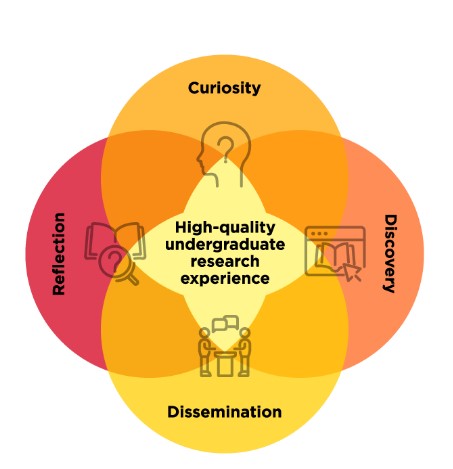
You can explore this framework and other resources in our UCalgary Guide for Undergraduate Research.
My strategy for our design consultation was to spend one session on each of these four elements. For each element, I asked a series of questions, made detailed notes, provided observations when I had experience to share, and followed up with reflections via email.
What I find most energizing about these consultations is taking this coaching approach rather than prescribing solutions. The specific solutions that emerge from these conversations are often ones I would never have conceived on my own!
Here are the questions I used to guide our exploration over the past several months:
🌱Curiosity
- What can you do to get students excited about research?
- How can you amplify the students’ curiosity about a topic?
- How can you model curiosity in your day-to-day interactions with students?
- How can you encourage or give time for students to tinker, make observations, play with ideas, and read widely before asking their research question?
- How can you help students take their curiosity and frame it as a feasible research question to investigate?
🧪 Discovery
- When and how will you show students the ‘big picture’ of what research is, and how research works?
- How much autonomy is expected of students and at what points in the research process?
- How many hours per week will students be expected to work on the research project? Outside of lab time?
- Is this a team or individual project? What aspects of the project are more appropriate for team vs individual work?
- What methodological training is needed to conduct the research?
- What safety training is required?
📢 Dissemination
- What key groups may be interested in the outcomes of this research? How could students be empowered to identify and connect with relevant groups?
- How can you reach your audience? What frameworks or support could you provide to help students develop their own creative approaches to sharing their research? How might you balance guidance with student autonomy in choosing dissemination methods?
- How could you create space for students to explore diverse formats for sharing their research? What structures would help them develop and implement their own innovative ideas for communicating findings?
- What level of exposure is appropriate for the research? How will you help students evaluate different scales of impact for their research dissemination? What considerations should guide decisions about reach while maintaining student ownership?
- What resources or support structures could you put in place to help students extend their research impact beyond the course? How might you facilitate continued engagement?
- How will you establish clear frameworks for recognizing contributions while encouraging students to take leadership in research dissemination? What principles should guide authorship and credit discussions?
🧠 Reflection
- What specific learning outcomes do you hope students will achieve through reflection?
- How might reflection help students connect their research experience to their broader academic journey or career goals?
- What types of insights do you hope students will gain that they might miss without structured reflection?
- What balance of individual and collaborative reflection might work best for your specific CURE?
- How might you create a safe space for students to honestly reflect on challenges and failures in the research process?
- What scaffolding might students need to develop more sophisticated reflection skills over time?
- How could reflection be integrated naturally into the research workflow rather than feeling like an add-on?
- What diverse formats for reflection (written, verbal, visual, etc.) might engage different types of learners?
- How might you help students see connections between their reflections at different stages of the research process?
- How will you provide feedback on students’ reflections to deepen their thinking?
- What strategies might help students use their reflections to improve their research practice?
- How might peer feedback enhance the reflection process?
I’ve noticed my questions evolving over time. Initially, I was very focused on what the instructor would be doing to get students to accomplish specific tasks. As I gained experience, I shifted my approach to better support students in taking ownership of their learning, with questions more focused on how instructors might help students evaluate and make decisions for themselves.
Through this process, Krista developed a fascinating CURE where students will work with Daphnia to investigate water quality issues in Alberta.🏞 I’m looking forward to our final meeting to review the complete design plan and can’t wait to see this project come to life next academic year!
Krista’s (very kind) thoughts on the process
“Collaborating with Kyla to develop a course-based research experience (CURE) for my first-year biology students was an incredibly valuable experience. It left me more excited to teach the course than I have been in some time!
The consultation process was organized and focused yet also adaptable with room for creativity and casual conversation. Each meeting we worked through several topic-specific questions, which Kyla sent in advance, so I had time to brainstorm. These questions were challenging in the best way and designed to make me think deeply about how I could incorporate the framework for high-quality research experiences into every aspect of the CURE. During our meetings Kyla demonstrated the same pedagogical methods that she was encouraging me to adopt such as building curiosity, guiding me to come up with answers instead of telling me what to do, and facilitating reflection by sending follow-up emails. Throughout the sessions, Kyla shared relevant resources and insightful teaching advice drawn from her own experience. These resources tied in nicely with the framework. A particular strategy I am excited to try with my students is the Question Formulation Technique, where students are empowered to formulate and select their own research question. Overall, the entire process was very effective and generated thoughtful and unique ideas for the CURE design.
Working with Kyla has definitely influenced how I think about student learning. I now understand that students will gain the most from their lab experience when they are actively engaged, continuously curious, and taking ownership over an experiment of their own design.”
What do you think?
Have you used frameworks or structured questioning to re-imagine an aspect of your teaching or leadership? What questions have helped you uncover new possibilities in your practice?
For more resources on designing undergraduate research experiences, check out our UCalgary Guide for Undergraduate Research.
 Kyla Flanagan
Leave a comment